Who is Banksy? The Street Artist Who Changed Everything
You've probably seen his work without even realizing it. That iconic image of a little girl reaching for a heart-shaped balloon? That's Banksy. The hotel with "the worst view in the world" next to a concrete wall in Palestine? Banksy again. The painting that literally shredded itself the moment it sold for over a million pounds? You guessed it.

Who is Banksy, Really?
Here's what we know for sure: Banksy is a British street artist who's been creating politically charged graffiti since the late 1980s. He's from Bristol, probably born around 1974, and he's managed to keep his real name secret for over three decades – which is pretty incredible when you think about it.
What makes this guy so special isn't just his art (though we'll get to that). It's the fact that he's turned anonymity into an art form itself. In a world where everyone's fighting for Instagram followers and reality TV spots, Banksy has built a global empire by staying completely invisible. The man's never given a TV interview, never walked a red carpet, never even confirmed his real name. It's like he's playing the world's longest game of hide and seek.
We do have some clues about who he might be. He's mentioned being middle-class, going to private school, and starting out as part of Bristol's DryBreadZ graffiti crew in the '90s. Some people think he's Robin Gunningham, a guy from Bristol who fits the profile. Others swear he's Robert Del Naja from the band Massive Attack. There's even a theory that "Banksy" is actually multiple people working together, which would explain how his work shows up simultaneously in different countries.
But honestly? The mystery is half the appeal.
From Bristol Walls to Million-Dollar Auctions
Banksy didn't start out planning to become the world's most expensive vandal. Like most graffiti artists in the late '80s, he was just a kid with a spray can and something to say. But while other artists were perfecting their tags, Banksy was developing something different – those crisp, black-and-white stencils that would become his signature.
The genius of stencils isn't just artistic; it's practical. When you're illegally spray-painting walls, speed matters. Police don't wait around while you finish your masterpiece. Stencils let Banksy create complex, detailed images in minutes, then disappear into the night.
His early work around Bristol and London was raw, angry, and brilliant. While other street artists were focused on style and territory, Banksy was making statements. His rats became symbols of urban decay and resilience. His policemen kissing and soldiers with smiley faces challenged authority with humor and subversion.
Then something funny happened. The art world, which had spent decades looking down on graffiti as mere vandalism, suddenly couldn't get enough of this anonymous rebel from Bristol.
The Art That Stopped the World
Let's talk about some of the pieces that made Banksy a household name.
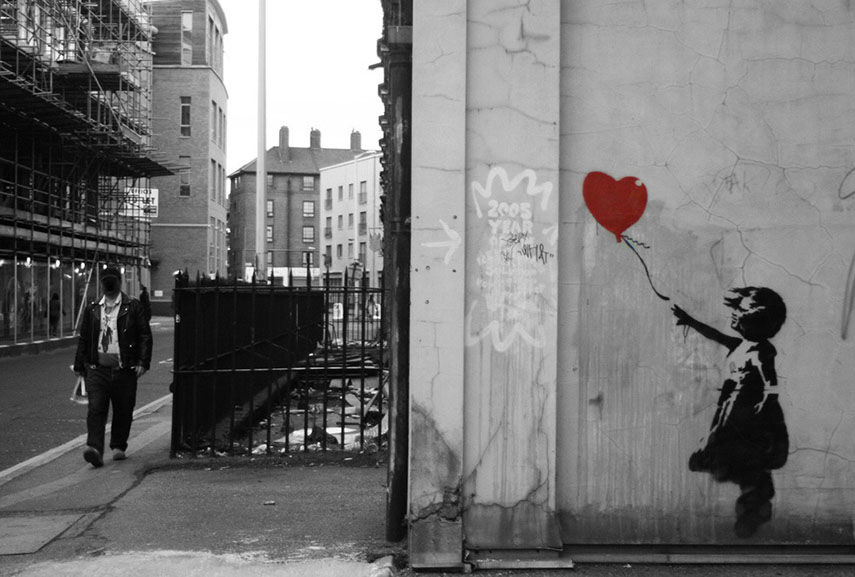
Girl with Balloon might be the most recognizable image of the 21st century. It's deceptively simple – just a young girl reaching toward a heart-shaped red balloon floating away. But there's something about it that hits you right in the chest. Is she losing the balloon or releasing it? Is it about loss or letting go? The beauty is that it works either way.
This piece became legendary in 2018 when a framed version sold at Sotheby's for £1.04 million. The moment the hammer fell, the artwork began shredding itself through a mechanism hidden in the frame. The auction house was stunned. The art world was in uproar. And Banksy? He posted a video showing he'd built the shredder into the frame years earlier, just waiting for this moment.
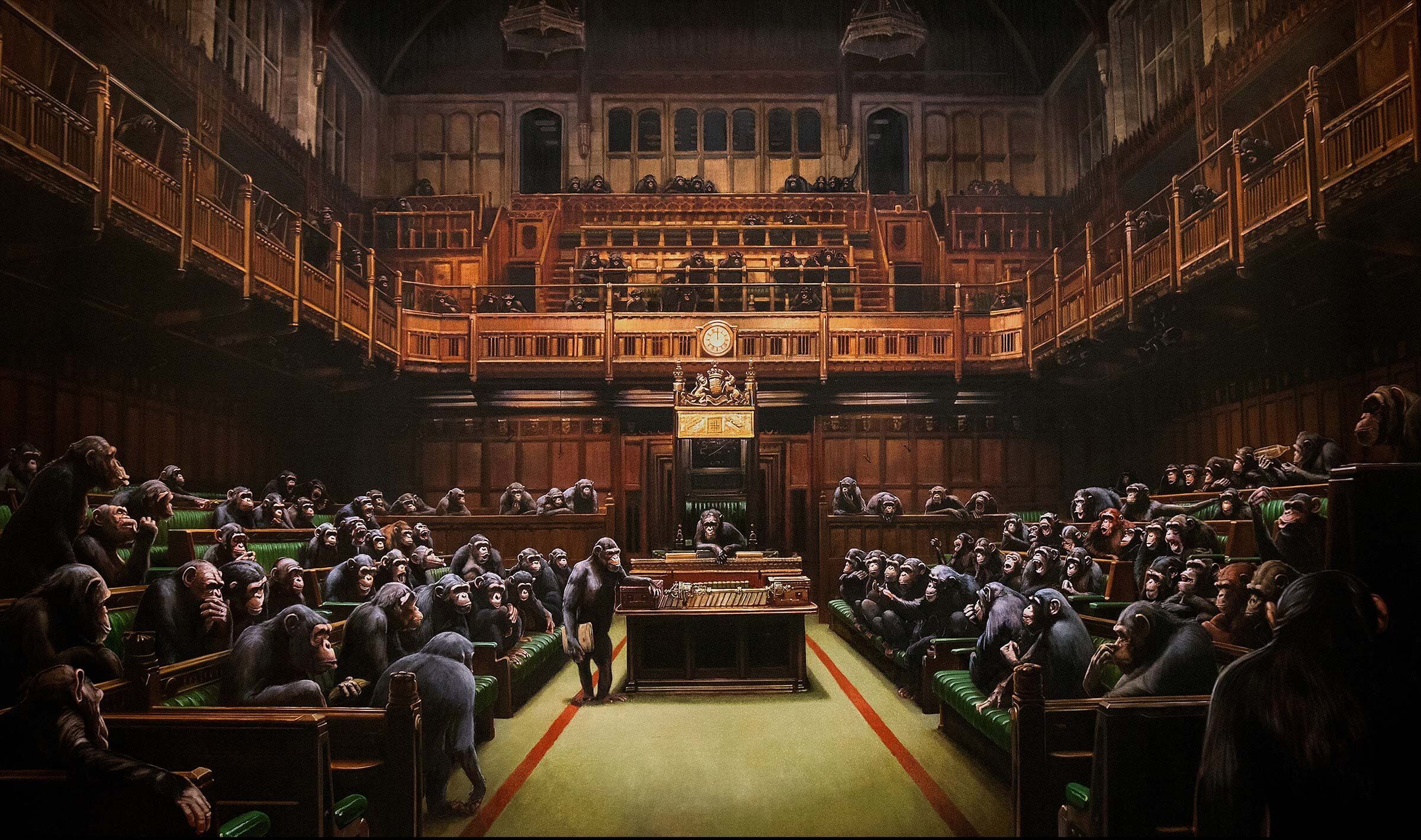
Devolved Parliament shows the UK House of Commons filled with chimpanzees instead of MPs. Created in 2009, it sold for over £12 million in 2019, making it the most expensive Banksy ever sold. The timing couldn't have been better – or worse, depending on your perspective – hitting the market during Brexit chaos when British politics felt more like a zoo than ever.

Season's Greetings appeared overnight on a garage wall in Port Talbot, Wales, in 2018. From one side, it looks like a child playing in falling snow. Walk around to the other side, and you realize the "snow" is actually ash from a burning dumpster. It's environmental activism disguised as Christmas card, and it's absolutely devastating.
The Walled Off Hotel: Art Meets Activism
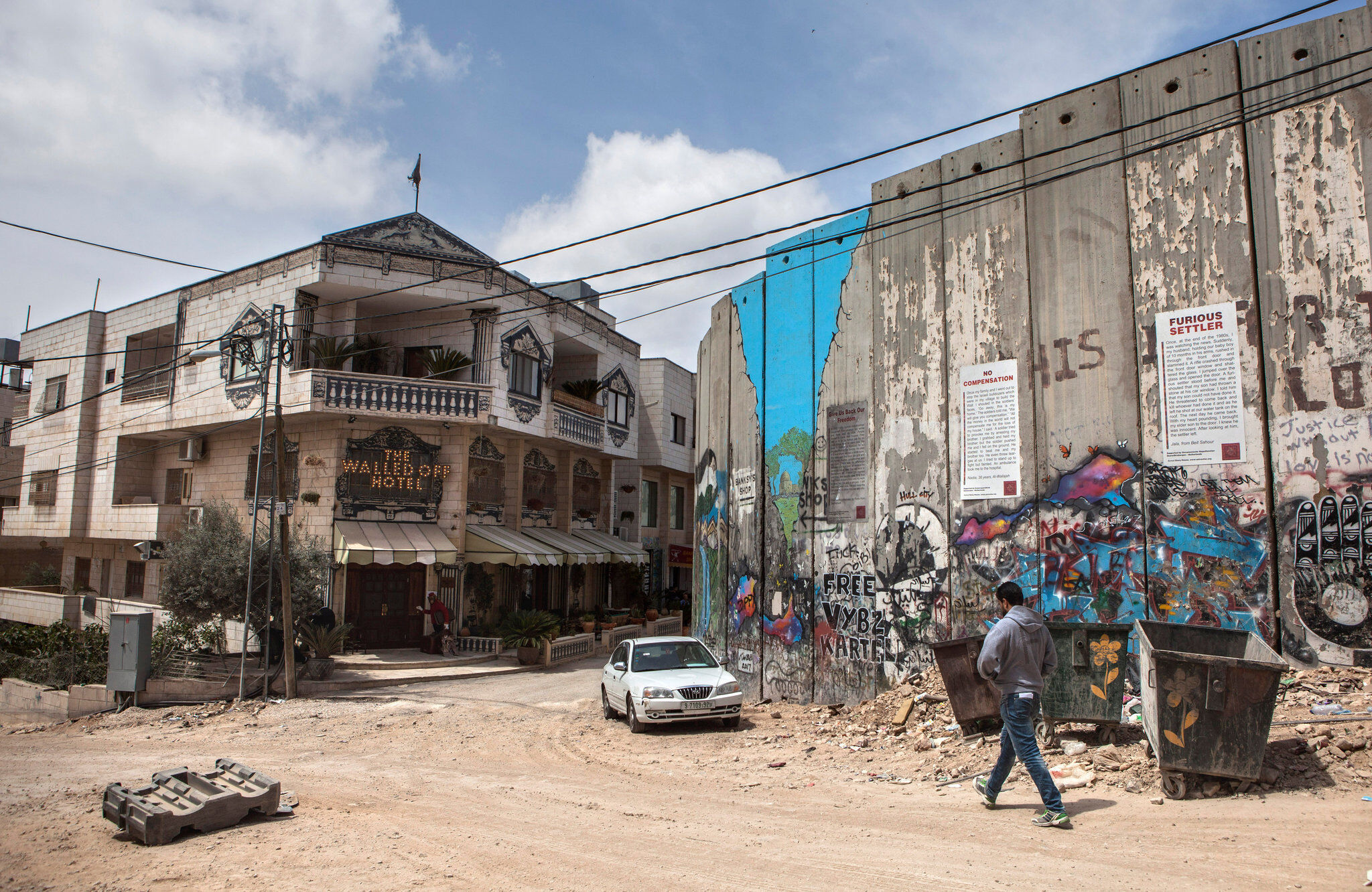
In 2017, Banksy opened what he called "the hotel with the worst view in the world" – The Walled Off Hotel in Bethlehem, overlooking the Israeli separation wall. This wasn't just a political statement; it was a fully functioning hotel where guests could stay in rooms decorated with Banksy originals while staring at one of the world's most controversial barriers.
The hotel operated for several years, hosting art exhibitions, film screenings, and political discussions. It was Banksy at his most ambitious – not just creating art about political issues, but creating spaces where people could experience and discuss them firsthand.
The Authentication Game
Here's where things get really interesting. When your identity is secret and your art appears illegally on public walls, how do you prove what's real and what's fake?
Banksy solved this with Pest Control, his official authentication service. They're the only authority that can verify whether a piece is genuine Banksy or just a very good copy. This matters because authenticated Banksy works sell for millions, while unverified pieces are essentially worthless.
The process is deliberately mysterious. Pest Control doesn't explain their methods, and they don't authenticate everything. Sometimes they'll verify a piece years after it appeared; sometimes they'll never confirm works that everyone assumes are real. It's all part of maintaining the mystique.
Why Banksy Matters (And Why People Pay Millions)
You might wonder how someone who started as a vandal ended up with pieces in the British Museum and private collections worth more than most people's houses. The answer is that Banksy tapped into something powerful: the hunger for authentic voices in an increasingly artificial world.
His art works on multiple levels. On the surface, it's visually striking and often funny. Look deeper, and you'll find sharp political commentary about war, poverty, consumerism, and power. But perhaps most importantly, it feels genuine in a way that much contemporary art doesn't.
Banksy's anonymity is crucial to this authenticity. Without a face or personality to market, the work has to speak for itself. There's no celebrity backstory, no art school pedigree, no gallery connections. Just powerful images that make you think, laugh, or sometimes feel uncomfortable.
Major collectors and museums now compete for Banksy pieces not just because they're valuable, but because they represent a moment when art broke free from galleries and spoke directly to the streets. His work captures the spirit of rebellion that many people feel but can't express.
The Banksy Effect on Cities
When a new Banksy appears, it's like lightning striking. Within hours, crowds gather. Local news crews arrive. The city has to decide: preserve it or paint over it? Many of his pieces have been removed from their original locations and sold, sometimes for millions.
This creates a strange dynamic. Banksy's art often criticizes capitalism and gentrification, but his presence can actually increase property values and attract tourists. It's one of the contradictions that makes him such a fascinating figure.
Some cities have embraced their Banksy pieces as tourist attractions. Others have tried to remove them. A few have been destroyed by weather or vandalism. Each piece becomes a small drama about art, ownership, and public space.
The Digital Age Banksy
Despite his old-school street art roots, Banksy has mastered modern media. His Instagram account, with millions of followers, is the primary way he announces new work and confirms authenticity. It's also where he shares his thoughts on current events, usually through new pieces that appear overnight and get posted the next morning.
This digital presence has become crucial for authentication and market value. If it's not on his Instagram, it's probably not real. This system has worked well, though it's also been exploited by scammers creating fake Banksy NFTs and unauthorized merchandise.
What's Next for the World's Most Famous Anonymous Artist?
Banksy shows no signs of slowing down. New pieces continue to appear around the world, each one generating headlines and speculation. His recent work has addressed everything from COVID-19 to racial justice to environmental destruction.
The question isn't whether Banksy will remain relevant, but whether he can maintain his anonymity in an increasingly connected world. Every time he creates a new piece, amateur detectives try to trace his movements. Security cameras are everywhere. DNA testing is getting cheaper. Yet somehow, he keeps slipping through the cracks.
Maybe that's the point. In a world where privacy is disappearing and authenticity is rare, Banksy represents something we're all hungry for: the possibility that you can still make a difference without selling your soul or your story.
The Man Behind the Myth
So who is Banksy? He's a artist who figured out how to change the world without revealing his face. He's a businessman who built a multi-million dollar brand while staying completely anonymous. He's a political activist who uses humor and art instead of protests and speeches.
But more than anything, he's proof that in our over-connected, over-shared world, sometimes the most powerful thing you can do is stay hidden. His art speaks so loudly that his voice doesn't matter. His images are so strong that his face is irrelevant.
Whether you see him as a brilliant artist, a clever marketer, or a lucky vandal, one thing is clear: Banksy has changed how we think about art, anonymity, and the power of a single image to capture the world's attention.
And he's done it all without anyone knowing his real name. In 2025, that might be the most impressive trick of all.